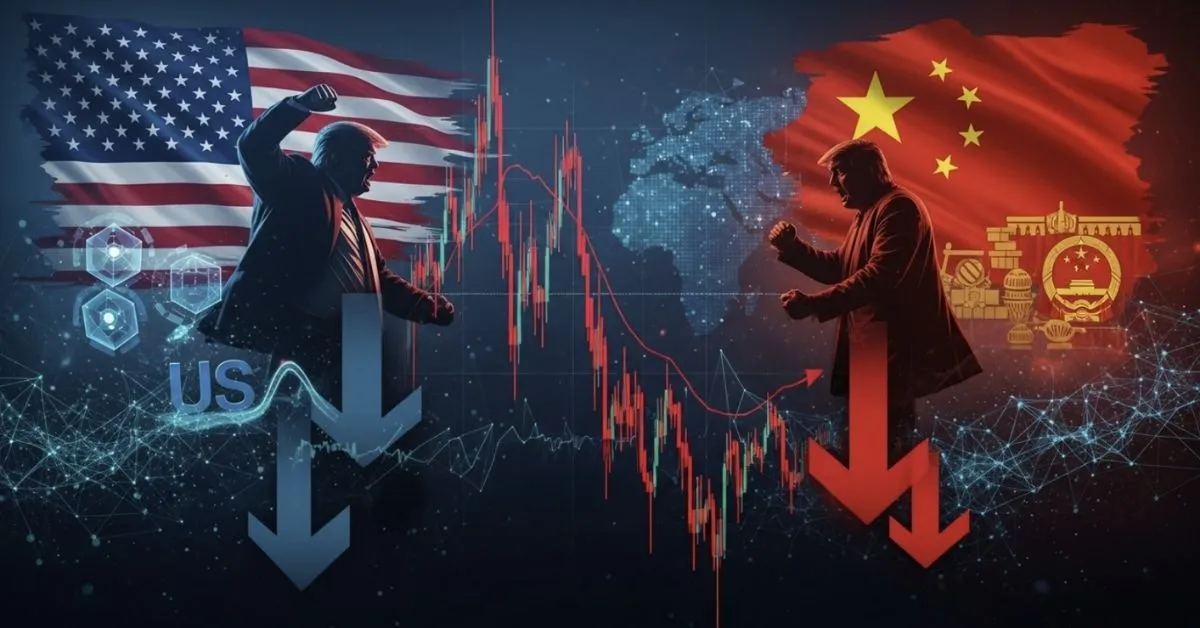
US-China Trade War & Crypto: In-Depth Analysis
US-China Trade War Escalates: Trump's Tariff Storm Rocks Crypto Market Ưith Record Turmoil
President Donald Trump has confirmed that the United States is in an active trade war with China, after he threatened to impose a 100% tariff on all goods imported from China. This shocking news, released on October 10, 2025, caused a significant drop in the cryptocurrency market, accompanied by large-scale liquidations and a shift in investor sentiment, wiping hundreds of billions of USD in market capitalization in just a few hours.
The developments in the US-China trade war triggered one of the largest risk-asset liquidations in cryptocurrency history, demonstrating the market's sensitivity to geopolitical tensions.
Background And Key Developments Of The Trade Tensions
The event began when President Donald Trump, via a social media post on October 10, 2025, threatened to impose a 100% tariff on imports from China. This move was a direct response to China's new policy requiring foreign entities to obtain licenses to export goods containing more than 0.1% rare earth minerals, along with imposing export controls on software and other critical technology products.
On Friday afternoon, US time, President Trump officially confirmed the imposition of 100% tariffs, stating they would take effect from November 1. He also canceled a previously scheduled meeting with Chinese President Xi Jinping. By October 15, Trump further asserted, "we are in a trade war" and "we have 100% tariffs."
China's response was equally resolute. The Chinese Ministry of Commerce warned it was ready to "fight to the end," defended its rare earth export control measures as legitimate, and announced countermeasures against five US-related companies. Beijing also began imposing new port fees on US shipping operations.
Far-Reaching Impact On The Cryptocurrency Market
Immediately following Trump's announcement, the cryptocurrency market experienced an unprecedented "flash crash" or "sharp sell-off," with many coins seeing double-digit price declines.
Position Liquidations And Massive Losses
This is considered one of the largest liquidation events in cryptocurrency history, with an estimated 9.4 billion USD to 19.5 billion USD in positions liquidated across the entire cryptocurrency market within just 24 hours. Over 1.5 million traders were affected, with approximately 8 billion USD in losses coming from "long" positions, underscoring the severity of the event.
Hundreds Of Billions Of USD In Market Cap Evaporated
The total cryptocurrency market capitalization fell over 9% to 3.8 trillion USD on Friday. A second, even more severe downturn, wiped out nearly 200 billion USD of crypto market capitalization in just a few hours. Some other sources even reported a total of 400 billion USD lost from the cryptocurrency market value in less than 24 hours, indicating an unprecedented scale of damage.
Performance Of Specific Cryptocurrencies
• Bitcoin (BTC): BTC prices plummeted from approximately 122,500 USD to a low of 104,600 USD (a 15% drop), or from 122,000 USD to 107,000 USD (a 10% drop), and even to 102,000 USD on Binance. For the week, Bitcoin was down 8% to 110,534 USD.
• Ethereum (ETH): ETH saw declines ranging from 11% to over 20%, settling around the 3,500 USD mark.
• Dogecoin (DOGE): This meme coin dropped over 50% in a short period, or 17.7% to 20% on weekly charts.
• Solana (SOL): SOL fell below 140 USD (a 14% drop), with an overall decline of 10-20%.
• Other Altcoins: Many other top altcoins like XRP and BNB dropped over 15%. Notably, President Donald Trump's own token, $TRUMP, also couldn't escape the fate, declining by about 63%.
Weak Recovery And Continuous Volatility
Prices partially recovered after Trump hinted at possibly retracting tariffs or after the meeting between Trump and Xi Jinping was confirmed. However, the market remained highly volatile, with the Fear and Greed Index returning to the "Fear" zone, reflecting investors' anxiety and uncertainty.
Reasons Behind The Cryptocurrency Market's Reaction
Several converging factors amplified the trade war's impact on the crypto market.
Risk-Off Sentiment
The escalating trade war triggered a "sell-off of risky assets like tech stocks and cryptocurrencies" and a "shift to safe-haven assets like gold and silver." Investors quickly withdrew funds from volatile assets and moved into safer havens such as cash or government bonds.
Leverage Effect
The downturn was exacerbated by the large number of traders using high leverage. Forced liquidations significantly contributed to the market's scale and shock, creating a negative domino effect.
Global Economic Instability
Concerns about global economic growth prospects, tensions in the global technology supply chain (especially semiconductors, AI, and blockchain infrastructure), and potential inflation due to tariffs added to overall financial market instability and anxiety.
Profit-Taking
After months of strong gains, investors took advantage of the uncertain policy environment to take profits, especially as the market had reached new price peaks.
Market Vulnerability and Liquidity
The historic 19 billion USD futures liquidation event in the US exposed the cryptocurrency market's vulnerability. The market's operational characteristics, with lower liquidity as traders massively withdrew funds, propelled the sharper decline.
Broader Financial Market Context
• Traditional Markets: The tech-heavy Nasdaq Composite dropped 3.56%, and the S&P 500 recorded its worst day since April. Major tech companies like Amazon, Nvidia, and Tesla saw 770 billion USD in market capitalization wiped out.
• US stock futures and cryptocurrency prices both experienced a sharp sell-off.
• Gold and silver traded at record highs, serving as familiar safe-haven assets amid uncertainty.
The current escalation is reminiscent of the 2018-2019 trade war, when Bitcoin showed similar patterns of short-term declines followed by quick recoveries, suggesting the market's resilience.
Perspective And In-Depth Analysis
Cryptocurrency Volatility and Resilience
Despite significant volatility, cryptocurrencies (especially Bitcoin) are increasingly seen as a valuable hedge, operating beyond the control of government policy decisions, and tending to recover quickly after shocks. This capability strengthens their long-term position as "digital gold."
Market Maturation
Professional investors remained relatively calm, indicating that the cryptocurrency market is gradually maturing and better equipped to handle volatility. The losses during this downturn were primarily confined to individual investors using high leverage.
Insider Trading Concerns
The timing of a large short position placed by an anonymous investor just 30 minutes before Trump's announcement raised serious suspicions of insider trading, an ever-present issue in highly volatile markets.
Long-Term Implications
Escalating trade disputes could have long-term implications for the cryptocurrency mining industry, as most hardware and semiconductors are produced in China, potentially driving up mining costs. In the long run, deglobalization and capital controls could strengthen the "digital gold" narrative for Bitcoin and cross-border stablecoin use cases, as nations seek independent payment and value storage solutions beyond traditional, politically influenced financial systems.
Conclusion
The trade war between the US and China under President Donald Trump has once again demonstrated that the cryptocurrency market, though nascent, is deeply affected by macroeconomic and geopolitical events. The record sell-off and liquidations serve as a reminder of the risks associated with high leverage and the necessity of a cautious investment strategy. However, Bitcoin's quick recovery and the composure of professional investors also indicate that the market is gradually maturing and finding a more stable footing in a volatile global economic landscape.
Disclaimer: This article is intended solely to provide information and market insights at the time of publication. We make no promises or guarantees regarding performance, returns, or the absolute accuracy of the data. All investment decisions are the sole responsibility of the reader.