Google Willow: Quantum Chip 13,000x Faster Than Supercomputers
Google Achieves Quantum Breakthrough: Willow Chip 13,000x Faster Than Supercomputers
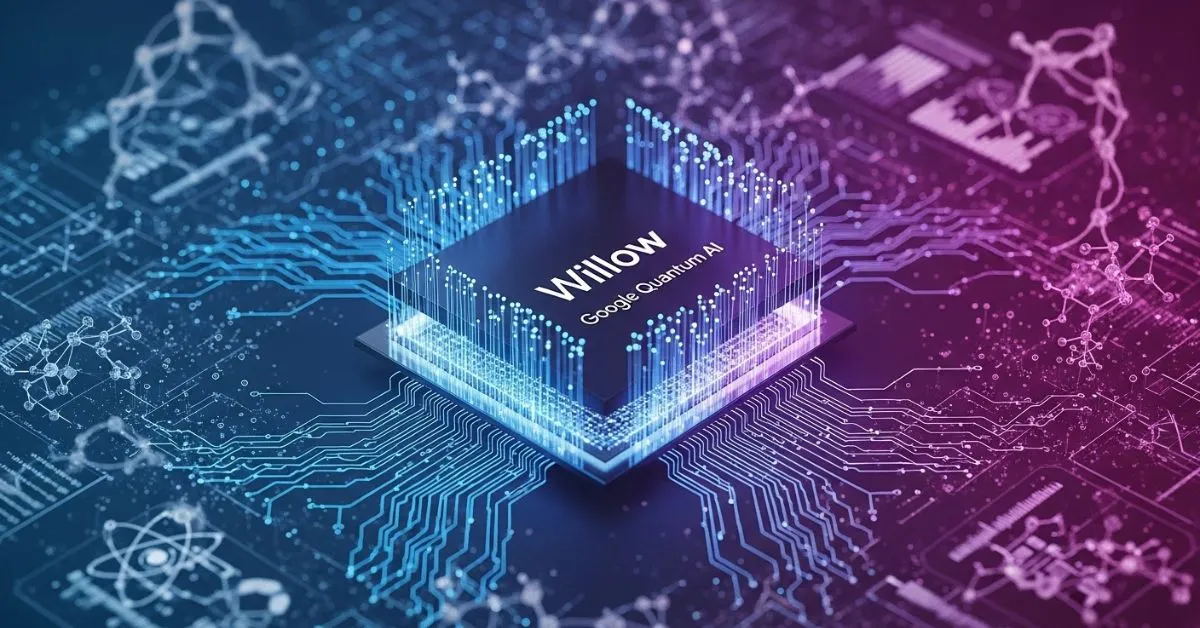
Google Quantum AI has announced a landmark achievement, ushering in a new era for quantum computing. With its Willow quantum chip and the groundbreaking Quantum Echoes algorithm, Google has demonstrated the ability to solve a complex computational task up to 13,000 times faster than the fastest conventional supercomputers available today. This is not merely a speed record, but the first verifiable demonstration of “quantum advantage” on real hardware, bringing quantum technology closer to real-world applications.
The Achievement Of The Willow Chip And Quantum Echoes Algorithm
At the heart of this breakthrough is Google's Willow quantum chip, featuring 105 superconducting qubits, and the innovative Quantum Echoes algorithm. This algorithm, also known as the out-of-time-order correlator (OTOC), is designed to measure how quantum information spreads through a system. In the experiment published in Nature journal, the Willow chip completed a calculation that would have taken the Frontier supercomputer – one of the world's most powerful machines – approximately 3.2 years to perform, while Willow accomplished it in just over two hours. This drastic difference in time represents an astonishing leap in computational capability.
Verifiable Quantum Advantage
A crucial aspect that differentiates this achievement from previous claims of “quantum supremacy” (such as Google’s Sycamore chip in 2019) is its independent verifiability. Google researchers emphasize that the results of Quantum Echoes can be replicated and verified by other quantum computing systems with equivalent specifications, or even through real-world physical experiments. This verifiability is an incredibly important factor, shifting quantum computing from a theoretical concept to a reliable scientific tool.
Potential Applications Of Quantum Technology
The potential applications of the Willow chip and Quantum Echoes algorithm are vast. Google states that this technique can be useful in understanding the structure of systems in nature, from molecules and magnets to black holes. Specifically, it can be used to analyze atomic interactions in real-world molecules, thereby accelerating research in fields like drug discovery, materials science, and personalized healthcare through faster and more detailed molecular simulations. Furthermore, this technology could extend the reach of nuclear magnetic resonance (NMR) spectroscopy – a vital tool for understanding chemical structures.
Future Outlook
Scientists at Google Quantum AI, including Michel Devoret, head of Google's quantum AI unit and a Nobel laureate in Physics, have hailed this result as “another important milestone” in the journey of quantum computing development. This achievement is considered a significant step towards building large-scale, fault-tolerant quantum computers, with the goal of achieving practical applications within the next five years. Quantum computing promises to revolutionize numerous industries, from medicine and energy to data security, though significant challenges remain to be overcome.
Conclusion
With the Willow chip and the Quantum Echoes algorithm, Google Quantum AI has not only achieved a speed record but has also provided clear and verifiable proof of quantum advantage. This advancement not only solidifies Google's leading position in quantum computing but also opens new doors for solving complex problems that even the most powerful supercomputers struggle with, promising a future full of potential for science and technology.
Disclaimer
The content above reflects the author's personal views only and does not represent any official stance of Cobic News. The information provided is for reference purposes only and should not be considered investment advice from Cobic News.